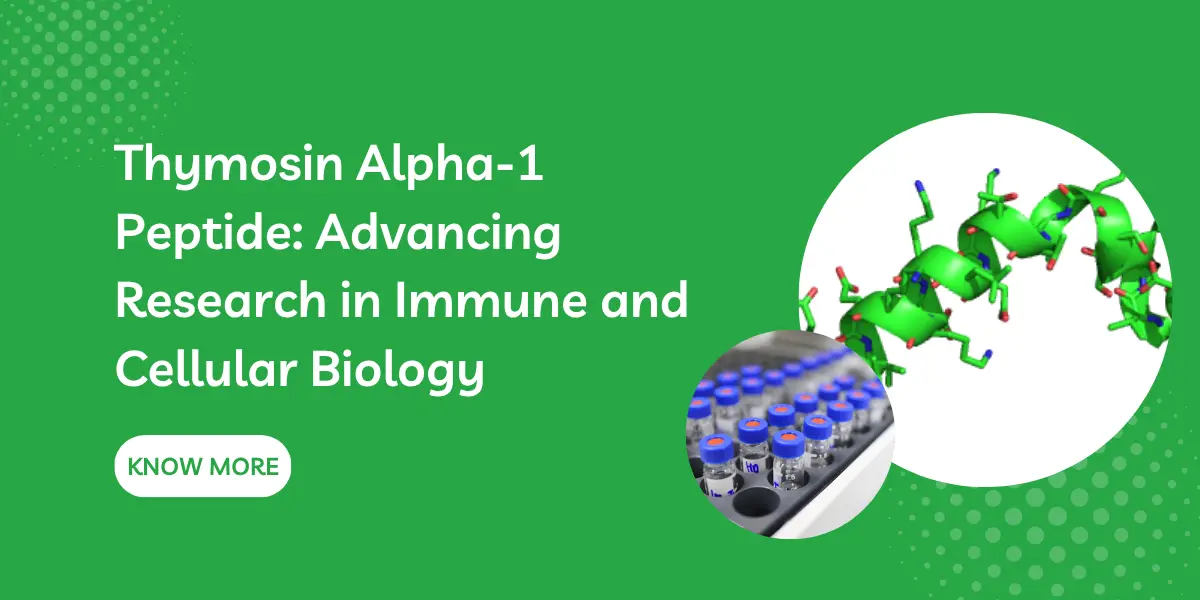
The thymus, a key organ of the immune system, plays a pivotal role in the development and maturation of T lymphocytes, which are essential for adaptive immunity. Thymosins, a family of small peptides primarily secreted by the thymus, have emerged as critical regulators of immune function and cellular homeostasis. Among these, Thymosin Alpha-1 (Tα1), a 28-amino-acid polypeptide, has gained extensive attention in immunology and cell biology research due to its multifaceted biological activities. This review summarizes the structural characteristics, molecular mechanisms, and recent research progress of Tα1, highlighting its potential applications in immunomodulation, disease intervention, and cellular function regulation.
Structural Characteristics and Biosynthesis
Thymosin Alpha-1 is a naturally occurring peptide derived from the precursor protein prothymosin α (ProTα), which is encoded by the PTMA gene. It consists of 28 amino acid residues with the sequence Ac-Ser-Asp-Ala-Ala-Val-Asp-Thr-Ser-Ser-Glu-Ile-Thr-Thr-Lys-Asp-Leu-Lys-Glu-Lys-Lys-Glu-Val-Val-Glu-Glu-Ala-Glu-Asn-OH. The N-terminal acetylation of Tα1 is a critical structural feature that enhances its stability and biological activity, protecting it from degradation by aminopeptidases in the circulatory system.
Biosynthetically, Tα1 is produced through the proteolytic cleavage of ProTα, a highly conserved protein widely expressed in various tissues and cell types beyond the thymus, including the spleen, liver, and immune cells. This widespread expression suggests that Tα1 plays a broader role in cellular physiology beyond its classical function in thymic T cell maturation.
Immunomodulatory Mechanisms
Tα1 exerts profound immunomodulatory effects by regulating the development, activation, and function of various immune cells, thereby maintaining immune homeostasis and enhancing host defense against pathogens and abnormal cells. Its mechanisms of action in immunology are diverse and well-documented.
Regulation of T Lymphocyte Development and Function
As a key thymic peptide, Tα1 is critical for the maturation of T lymphocytes. It promotes the differentiation of thymocytes into mature CD4+ and CD8+ T cells by upregulating the expression of T cell receptor (TCR) and co-stimulatory molecules (e.g., CD28, CD40L). In mature T cells, Tα1 enhances their activation, proliferation, and cytokine secretion, particularly increasing the production of pro-inflammatory cytokines such as interleukin-2 (IL-2), interferon-γ (IFN-γ), and tumor necrosis factor-α (TNF-α), which are essential for adaptive immune responses against viral and bacterial infections.
Modulation of Innate Immune Cells
Tα1 also regulates the function of innate immune cells, including macrophages, dendritic cells (DCs), and natural killer (NK) cells. It enhances the phagocytic activity of macrophages and their ability to present antigens, thereby bridging innate and adaptive immunity. For DCs, Tα1 promotes their maturation and antigen-presenting capacity, facilitating the activation of naive T cells. Additionally, Tα1 boosts the cytotoxic activity of NK cells, enabling them to effectively recognize and eliminate virus-infected cells and tumor cells.
Immune Restoration in Immunocompromised States
A key feature of Tα1 is its ability to restore immune function in immunocompromised conditions, such as chronic infections, cancer, and immunosuppressive therapy. It reverses T cell exhaustion, upregulates the expression of anti-apoptotic proteins (e.g., Bcl-2), and inhibits the production of immunosuppressive cytokines (e.g., IL-10, transforming growth factor-β (TGF-β)), thereby rebalancing the immune system. This property makes Tα1 a promising candidate for the treatment of immune-related disorders.
Roles in Cell Biology
Beyond its immunomodulatory effects, Tα1 plays important roles in cell biology, including regulating cell proliferation, apoptosis, and DNA repair, which are critical for maintaining cellular homeostasis and preventing disease progression.
Regulation of Cell Proliferation and Apoptosis
Tα1 promotes the proliferation of various cell types, including immune cells, epithelial cells, and fibroblasts, by activating signaling pathways such as the PI3K/Akt and MAPK/ERK pathways. It also inhibits apoptosis in normal cells by downregulating pro-apoptotic proteins (e.g., Bax, caspase-3) and upregulating anti-apoptotic factors. However, in abnormal cells such as tumor cells, Tα1 may exert pro-apoptotic effects, suggesting its potential as an anti-tumor agent.
DNA Repair and Cellular Stress Response
Recent studies have shown that Tα1 is involved in the regulation of DNA repair mechanisms. It upregulates the expression of DNA repair proteins (e.g., ATM, ATR, p53) and enhances the repair of DNA damage induced by oxidative stress, radiation, or chemotherapy. This function not only protects normal cells from genotoxic damage but also contributes to the survival of immune cells in harsh microenvironments.
Research Progress and Potential Applications
In recent years, extensive research has explored the potential applications of Tα1 in various fields, including immunology, oncology, and infectious diseases.
Infectious Diseases
Tα1 has been widely studied for its role in combating viral infections, such as hepatitis B, hepatitis C, and COVID-19. It enhances the host immune response against viruses by activating T cells, NK cells, and DCs, thereby reducing viral load and improving clinical outcomes. Clinical trials have shown that Tα1, when combined with antiviral drugs, significantly improves the response rate in patients with chronic viral hepatitis.
Cancer Immunotherapy
In oncology, Tα1 is being investigated as an adjuvant for cancer immunotherapy. It enhances the anti-tumor immune response by activating effector T cells and inhibiting immunosuppressive cells (e.g., regulatory T cells, myeloid-derived suppressor cells). Preclinical studies have demonstrated that Tα1 can synergize with chemotherapy, radiotherapy, and immune checkpoint inhibitors to improve tumor regression and patient survival.
Immunodeficiency Disorders
Tα1 is also used in the treatment of primary and secondary immunodeficiency disorders, such as severe combined immunodeficiency (SCID) and acquired immunodeficiency syndrome (AIDS). It restores immune cell function and improves the ability of patients to resist infections.
Current Challenges and Future Perspectives
Despite the significant progress in Tα1 research, several challenges remain. The precise molecular mechanisms underlying its diverse biological activities, particularly its role in non-immune cells, require further investigation. Additionally, the optimal dosage, administration route, and long-term safety of Tα1 in clinical applications need to be fully evaluated.
Future research should focus on elucidating the upstream and downstream signaling pathways of Tα1, exploring its interactions with other molecules in the immune and cellular networks, and developing novel Tα1 analogs with enhanced bioavailability and specificity. With the continuous advancement of immunology and cell biology, Tα1 is expected to play an increasingly important role in the prevention and treatment of immune-related diseases and cancer, providing new insights into cellular regulation and host defense.